The weather has been cool. The light amazing. The crickets have slowed their rhythms to indicate the coming of fall. So these mornings I've been book-worming it out on the patio instead of indoors. We just moved to this house in a historic North East Kansas City neighborhood over the summer, so these cool mornings outdoors are brand new. At our midtown apartment, we had a balcony where I'd sit and read in the mornings until a line or two would come to me. But things sounded different there--there were layers upon layers of noise: dogs barking out to car alarms up to the rotor thwup-thwup of the ghetto birds out to Main Street traffic bass and horn out to the highways with the sad thrum of truck tires and the sounds of commerce droning on and on out into the day. Here, a polyphonic quiet slowly lifts itself from the mornings. A kind of quiet that isn't silent but something else. Anyway, I've taken a break from the Notes for a Memoir manuscript and have been writing poems in sections, something I had not done too much of before. Here are two (of six) sections from a poem I've written from the patio surrounded by the *quiet*.
3.
Just then was the quiet.
I would swear to its having
been the unmouthed voice
of the quiet. Listen,
I would indicate silence
to the boy with my hand
upheld, severing his speech
from the air. Could you
hear the quiet rolling
out from the Eastern hill?
But I have no son and
the quiet I heard was no
more than the trains lost
once again to the distance
between here and there.
4.
I’m certain of the quiet
in the way a man is certain
of anything. Up all night,
the Certain Man will smoke
all his cigarettes one by one
like there was no tomorrow.
Before the street lights
stub themselves out,
before he creaks open
the car door and seals
his certain mode within,
intent on the convenience
store, he will let the quiet tear
the dawn into halves, smugly
handing over the first
before pocketing the other.
In this regard, I am less
than a Certain Man. I will stay
here. I will merely pit the quiet
voice against the gentle wind,
uncertain of the exact
terms of our transaction.
Saturday, September 20, 2008

Thursday, September 11, 2008
the rhythm of joy

Currently reading David Lehman's The Last Avant-Garde, The Making of the New York School of Poets. Only sixty pages in, but I thought I should report the most impressive biographical fact read so far: At Harvard, Kenneth Koch, a 21-year old rifleman just returned from WWII, wrote his class notes in unrhymed iambic pentameter. He wrote his class notes in iambic pentameter! Reading this last night, I barely suppressed the urge to yell the news through the house. I mean, what bio detail could epitomize he, Ashbery and O'Hara's playful-with-the-serious aesthetic more? But I bit my tongue. My wife, angrily reading plogs, would not have been as impressed as you.
Tuesday, September 2, 2008
Girls
Back to school. The third week starts today. Now I have to shower and make the commute...but quickly, guess how many of my 15 gifted & talented sixth graders are girls?
Give up?
No?
14?
You were close.
12!
Yeah, there are only 3 boys. I've been teaching GT, 6th through 8th grades, for seven years now. And the girl to boy ratio has never been so imbalanced. I'm the oldest of three boys. So I know boys pretty well. Now I'm planning to do some reading on girls. Please recommend books, if you know of any.
Give up?
No?
14?
You were close.
12!
Yeah, there are only 3 boys. I've been teaching GT, 6th through 8th grades, for seven years now. And the girl to boy ratio has never been so imbalanced. I'm the oldest of three boys. So I know boys pretty well. Now I'm planning to do some reading on girls. Please recommend books, if you know of any.
Wednesday, August 13, 2008
Thank you, Neruda
I have been restless with reading poems lately. My dad was diagnosed with cancer a month ago (stage one renal cell carcinoma), and so many poems written in the detached, elliptical style now all the rage just haven't spoken to me from human voices*. But this isn't a complaint, really, just an observation I'm sounding out, however trite--a reminder of one of the reasons we, as readers of poems, dig into them in the first place.
Tonight I read these lines in a Neruda poem for the first time:
Death arrives among all that sound
like a shoe with no foot in it, like a suit with no man in it,
comes and knocks, using a ring with no stone in it, with no
finger in it,
comes and shouts with no mouth, with no tongue, with no
throat.
Nevertheless its steps can be heard
and its clothing makes a hushed sound, like a tree.
--from "Nothing but Death"
I set the book down on the chair, shivered and understood the strange textures of these lines as if they had occurred to me that day back in July. When I heard Dad has cancer, it was as if someone had made an incision in the air. It was a bright, hot day, and more than the sunlight leaked through the cut. Everything around me filled with his voice, his whistle in the morning when he'd rise and dress for work, his laughter in the kitchen late at night when we all talked and joked. Something cut at the air and threatened the fact of him and all the nouns in his possession (thank you, Brenda Coultas), and it threatened me and my family because we love him. But this wasn't like the horrible moments (these came later)...this moment was radiant and filled with a beauty heavy as the sun.
My grandfather on Dad's side ran a commercial fishing boat on the Delaware Bay, and Dad was first mate during his high school years. One of Dad's most lyrical stories has him standing on the bow one morning, watching four hammerheads glide in sync a thin layer beneath the glassy water, and they were beautiful until he broke away from the trance of their power moved by grace, their embodiment of life by way of death. Tonight, Neruda's poem inhabited an ordinary moment and recollected for me the way death intrudes into whatever we're doing in the meantime. The way it will flood the day with the strangest, most familiar light. Thank you, Neruda.
*There are exceptions, of course--Mary Jo Bang's ellipticism is always from such a lived-in space of ordinarily unspeakable emotion. Alex Lemon has written fantastic associative poems. And there are so many others who have genuinely embraced this aesthetic...so you line scribblers out there will have to forgive this generality missing half its sequins.
Tonight I read these lines in a Neruda poem for the first time:
Death arrives among all that sound
like a shoe with no foot in it, like a suit with no man in it,
comes and knocks, using a ring with no stone in it, with no
finger in it,
comes and shouts with no mouth, with no tongue, with no
throat.
Nevertheless its steps can be heard
and its clothing makes a hushed sound, like a tree.
--from "Nothing but Death"
I set the book down on the chair, shivered and understood the strange textures of these lines as if they had occurred to me that day back in July. When I heard Dad has cancer, it was as if someone had made an incision in the air. It was a bright, hot day, and more than the sunlight leaked through the cut. Everything around me filled with his voice, his whistle in the morning when he'd rise and dress for work, his laughter in the kitchen late at night when we all talked and joked. Something cut at the air and threatened the fact of him and all the nouns in his possession (thank you, Brenda Coultas), and it threatened me and my family because we love him. But this wasn't like the horrible moments (these came later)...this moment was radiant and filled with a beauty heavy as the sun.
My grandfather on Dad's side ran a commercial fishing boat on the Delaware Bay, and Dad was first mate during his high school years. One of Dad's most lyrical stories has him standing on the bow one morning, watching four hammerheads glide in sync a thin layer beneath the glassy water, and they were beautiful until he broke away from the trance of their power moved by grace, their embodiment of life by way of death. Tonight, Neruda's poem inhabited an ordinary moment and recollected for me the way death intrudes into whatever we're doing in the meantime. The way it will flood the day with the strangest, most familiar light. Thank you, Neruda.
*There are exceptions, of course--Mary Jo Bang's ellipticism is always from such a lived-in space of ordinarily unspeakable emotion. Alex Lemon has written fantastic associative poems. And there are so many others who have genuinely embraced this aesthetic...so you line scribblers out there will have to forgive this generality missing half its sequins.
Sunday, August 10, 2008
The Landscape Projected

Good friend Bryan Schutmaat stopped by Kansas City on his way back to Houston from Chicago, where he had been visiting our good friend Dave Gunn, recently expatriated (banished) from Lawrence & Dodge City, Kansas. See the creepy doctored photo of the three of us; from left to right: Dave, Bryan, and me last summer with a ridiculous stache (Danna was terrified for a month).
But we met up, caught up, and then dropped by the Human/Nature: Recent European Landscape Photography show at the Nelson-Atkins museum, where we carved up and ingested the phenomenal landscape photos by Bart Michaels, Andreas Gefeller and five others.
At 24, Bryan is already an accomplished photographer doing gorgeous work with landscape, interiors and portraits. We collaborated recently on a project tentatively titled The Slow Season. My first ekphrastic project, I let a series of his photographs tell me a story, which I recount in short blocks of prose, roughly one per photograph. Here's one of the fifteen photos that shut my mouth, that stilled my qwerty fingers:

On the way home to Houston, invigorated by the landscapes exhibit, Bryan shot this photo:
 He sent it to me in an e-mail, calling it "a bit derivative." I call it wonderful.
You can see more of Bryan's work in his Young Photographers United portfolio.
Friday, August 1, 2008
Notes on Baldness
With my thirty-fourth birthday coming up this month, I've been thinking about age and its signifiers in the male animal. Here are some random notes and observations on baldness:
-->100,000 follicles per scalp; each one will grow an average of 20 hairs per lifetime
-->Twenty-five percent of men begin balding by the time they hit 30; two-thirds of the male population in the U.S. will begin balding by age 60; average hair-loss is 100 strands each day; balding men lose upwards of 250 hairs each day
-->My friends and family started noticing my thinning hair at age 24; I started noticing my youngest brother Craig's thinning hair when he was 25, and my middle brother Matt's when he was 24. Dad's hair didn't start thinning until he was in his mid-thirties; grandpa Smith's hair started thinning when he was in his mid-twenties, and his two sons, Mom's brothers, each sport male pattern baldness.
-->So many people will never experience baldness. Here's what it's like to be bald(ing) from season to season:
-Winter: cold on top; a cotton or wool cap feels great, but so do the snowflakes or ice pellets
-Spring: April is the cruelest month; bald men half expect their crowns to bloom like the flowers
-Summer: sunburn is a serious threat to the 8-head; a blinding glare is also a concern
-Fall: the trees losing their leaves hearten the bald guy
-->There are many myths surrounding what causes baldness: Grandpa Smith, for example, told us he had gone bald from wearing a hat during his younger years. This was during the 1930s, 40s, and early 50s, when men wore hats. His sweaty hat band might have increased the bacteria count on his scalp, but I doubt there's a real correlation between haberdashery and baldness. I bet this was a myth perpetuated by a younger, newly hatless generation of men. It wasn't enough that their exposed plumage drew more looks from the ladies, they had to rub it in by suggesting that the hat was oppressive in more ways than one. Of course, I could be completely off-base with this speculation.
-Another myth about baldness is that scalp circulation, or a lack thereof, has something to do with baldness. This has been refuted; the secretion of a specific kind of hormone has more to do with it than anything; don't ask me about the physiology of baldness...Somewhere there's a great picture of novelist Saul Bellow standing on his head (couldn't find it online). I wonder if, aside from yoga and the obvious kick he and his friends got out of it, he did headstands because he believed he was preventing male pattern baldness. Here's a good pic of him upright in the 1960s, wearing a hat to cover his bald pate:


-->There are as many cultural stereotypes surrounding baldness as myths. Bald characters in recent television and movies build off of an archive of archetypal bald traits. Sometimes the bald character is portrayed as psychologically unstable, such as the pedophile (Jackie Hailey) in Little Children, whose half-submerged, sunburnt dome fitted in snorkel and mask at the public pool is conveyed as the most frightening specter imaginable to suburban families. Living with his mother, surrounded by curios, his bald head embodies an infantile state of mind. In another film, Sideways, the balding character Miles (Paul Giamatti) is hyper-sensitive, depressed and anxious. His wife divorced him two years earlier, and we can imagine he has lost upwards of two-hundred and fifty strands of hair each day since:

Bald and balding men can also be tough guys. Take television series The Shield's Vic Mackey (Michael Chiklis). A mercurial, nearly sociopathic kinesthetic genius. An effective vice cop who doesn't play by the rules because, as every teenage bully knows, the rules waste time and are followed by sissies. Vic is balding but, as evidenced by an atoll-like shadow of lateral hair, not completely bald. Since a full head of hair would gather resistance, he has chosen to shave his head slick and clean. His meathead could easily kick open doors, and I swear there's an episode where he headbutts a perp senseless.

On the positive end of the bald man spectrum, there are characters such as Jean Luc Picard (Patrick Stewart) who are seen as strong, virile, wise, and ethically superior to men with full heads of hair. Here's Pickard at the helm, making the difficult decisions:

-->In researching baldness on-line, I found out that many primate species lose hair following puberty. (Maybe we humans lose hair later because of our prolonged adolescence, and because we have a more advanced cerebral cortex that needs protecting?) Some species even convey increased status through a display of large foreheads; several species cheat by intentionally rubbing their heads bald to attain this status. This reminded me of certain teenage Morrissey fans back in the early nineties who cut faux widow's peaks in their hair to look more like him:

-In terms of baldness in human social evolution, researchers Muscavella & Cunningham speculate that baldness evolved in males through sexual selection as an enhanced signal of aging and social maturity. The bald head of an early human male, then, suggested a decline in risk-taking behaviors and an increase in nurturing ones beneficial to child-rearing. So maybe having less hair says to younger competitors: Dude, I'm older now, not as alluring or tough as you, maybe, but I've got a college education, a two-story house and a new Honda. You might, um, look out?
 -->Babies are bald. This might be the most unnerving consideration about balding. Losing your hair is a sort of return to a baby-like state of hairlessness. This frightens men, I think, because it makes physical the already palpable vulnerability of growing older:
 -->At nineteen, I was visited in a dream by a bald version of myself. He told me I was looking at what others would see forty years from now. But he was warm, confident and attractive, what old ladies (and my friend Robin) call a Silver Fox. He told me to not be afraid of who I would become. Nearly half-way there, I'm not afraid of turning into the old man who has lost his hair. But I am really dreading that old person smell.
-->100,000 follicles per scalp; each one will grow an average of 20 hairs per lifetime
-->Twenty-five percent of men begin balding by the time they hit 30; two-thirds of the male population in the U.S. will begin balding by age 60; average hair-loss is 100 strands each day; balding men lose upwards of 250 hairs each day
-->My friends and family started noticing my thinning hair at age 24; I started noticing my youngest brother Craig's thinning hair when he was 25, and my middle brother Matt's when he was 24. Dad's hair didn't start thinning until he was in his mid-thirties; grandpa Smith's hair started thinning when he was in his mid-twenties, and his two sons, Mom's brothers, each sport male pattern baldness.
-->So many people will never experience baldness. Here's what it's like to be bald(ing) from season to season:
-Winter: cold on top; a cotton or wool cap feels great, but so do the snowflakes or ice pellets
-Spring: April is the cruelest month; bald men half expect their crowns to bloom like the flowers
-Summer: sunburn is a serious threat to the 8-head; a blinding glare is also a concern
-Fall: the trees losing their leaves hearten the bald guy
-->There are many myths surrounding what causes baldness: Grandpa Smith, for example, told us he had gone bald from wearing a hat during his younger years. This was during the 1930s, 40s, and early 50s, when men wore hats. His sweaty hat band might have increased the bacteria count on his scalp, but I doubt there's a real correlation between haberdashery and baldness. I bet this was a myth perpetuated by a younger, newly hatless generation of men. It wasn't enough that their exposed plumage drew more looks from the ladies, they had to rub it in by suggesting that the hat was oppressive in more ways than one. Of course, I could be completely off-base with this speculation.
-Another myth about baldness is that scalp circulation, or a lack thereof, has something to do with baldness. This has been refuted; the secretion of a specific kind of hormone has more to do with it than anything; don't ask me about the physiology of baldness...Somewhere there's a great picture of novelist Saul Bellow standing on his head (couldn't find it online). I wonder if, aside from yoga and the obvious kick he and his friends got out of it, he did headstands because he believed he was preventing male pattern baldness. Here's a good pic of him upright in the 1960s, wearing a hat to cover his bald pate:
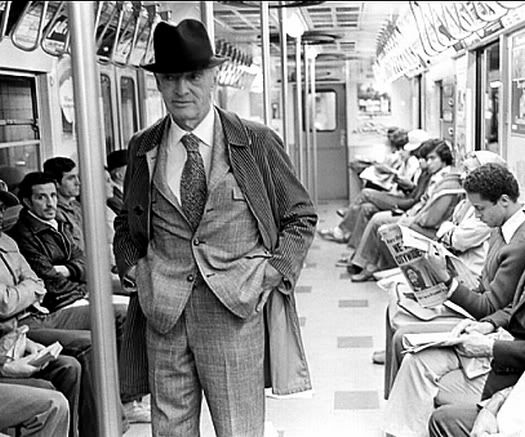
-->There are as many cultural stereotypes surrounding baldness as myths. Bald characters in recent television and movies build off of an archive of archetypal bald traits. Sometimes the bald character is portrayed as psychologically unstable, such as the pedophile (Jackie Hailey) in Little Children, whose half-submerged, sunburnt dome fitted in snorkel and mask at the public pool is conveyed as the most frightening specter imaginable to suburban families. Living with his mother, surrounded by curios, his bald head embodies an infantile state of mind. In another film, Sideways, the balding character Miles (Paul Giamatti) is hyper-sensitive, depressed and anxious. His wife divorced him two years earlier, and we can imagine he has lost upwards of two-hundred and fifty strands of hair each day since:

Bald and balding men can also be tough guys. Take television series The Shield's Vic Mackey (Michael Chiklis). A mercurial, nearly sociopathic kinesthetic genius. An effective vice cop who doesn't play by the rules because, as every teenage bully knows, the rules waste time and are followed by sissies. Vic is balding but, as evidenced by an atoll-like shadow of lateral hair, not completely bald. Since a full head of hair would gather resistance, he has chosen to shave his head slick and clean. His meathead could easily kick open doors, and I swear there's an episode where he headbutts a perp senseless.

On the positive end of the bald man spectrum, there are characters such as Jean Luc Picard (Patrick Stewart) who are seen as strong, virile, wise, and ethically superior to men with full heads of hair. Here's Pickard at the helm, making the difficult decisions:

-->In researching baldness on-line, I found out that many primate species lose hair following puberty. (Maybe we humans lose hair later because of our prolonged adolescence, and because we have a more advanced cerebral cortex that needs protecting?) Some species even convey increased status through a display of large foreheads; several species cheat by intentionally rubbing their heads bald to attain this status. This reminded me of certain teenage Morrissey fans back in the early nineties who cut faux widow's peaks in their hair to look more like him:

-In terms of baldness in human social evolution, researchers Muscavella & Cunningham speculate that baldness evolved in males through sexual selection as an enhanced signal of aging and social maturity. The bald head of an early human male, then, suggested a decline in risk-taking behaviors and an increase in nurturing ones beneficial to child-rearing. So maybe having less hair says to younger competitors: Dude, I'm older now, not as alluring or tough as you, maybe, but I've got a college education, a two-story house and a new Honda. You might, um, look out?
 -->Babies are bald. This might be the most unnerving consideration about balding. Losing your hair is a sort of return to a baby-like state of hairlessness. This frightens men, I think, because it makes physical the already palpable vulnerability of growing older:
 -->At nineteen, I was visited in a dream by a bald version of myself. He told me I was looking at what others would see forty years from now. But he was warm, confident and attractive, what old ladies (and my friend Robin) call a Silver Fox. He told me to not be afraid of who I would become. Nearly half-way there, I'm not afraid of turning into the old man who has lost his hair. But I am really dreading that old person smell.
Monday, July 28, 2008
beautiful again, & interesting, & modern
 Finished watching last night's season two premier of Mad Men (see yesterday's post). Shazam! As if we needed confirmation that it is the most culturally literate show around, the writers included a voice-over reading of the fourth section of Frank O'Hara's poem "Mayakovsky" in the closing scene. Read by the main character, Don Draper (played by Jon Hamm), the poem and the scene perfectly encapsulate his day in late-winter, in early mid-life, late mid-century.
Danna just found out that Frank O'Hara's book Meditations in an Emergency (Don Draper sees a sophisticated young man reading a copy in a Midtown lunch spot; and in a later scene we see he has purchased a copy) is one of today's most-Googled items. This is such positive exposure for American poetry readership! For many, reading O'Hara might be an inroad to more experimental poetries, both contemporary and historic.
Here's the fourth section of "Mayakovsky"*:
4
Now I am quietly waiting for
the catastrophe of my personality
to seem beautiful again,
and interesting, and modern.
The country is grey and
brown and white in trees,
snows and skies of laughter
always diminishing, less funny
not just darker, not just grey.
It may be the coldest day of
the year, what does he think of
that? I mean, what do I? And if I do,
perhaps I am myself again.
*Mayakovsky was a Russian poet whose poems O'Hara adored. John Ashbery notes in his introduction to The Collected Poems of Frank O'Hara: "...Mayakovsky, from whom he picked up what James Schuyler has called the 'intimate yell.'"
Subscribe to:
Posts (Atom)
